


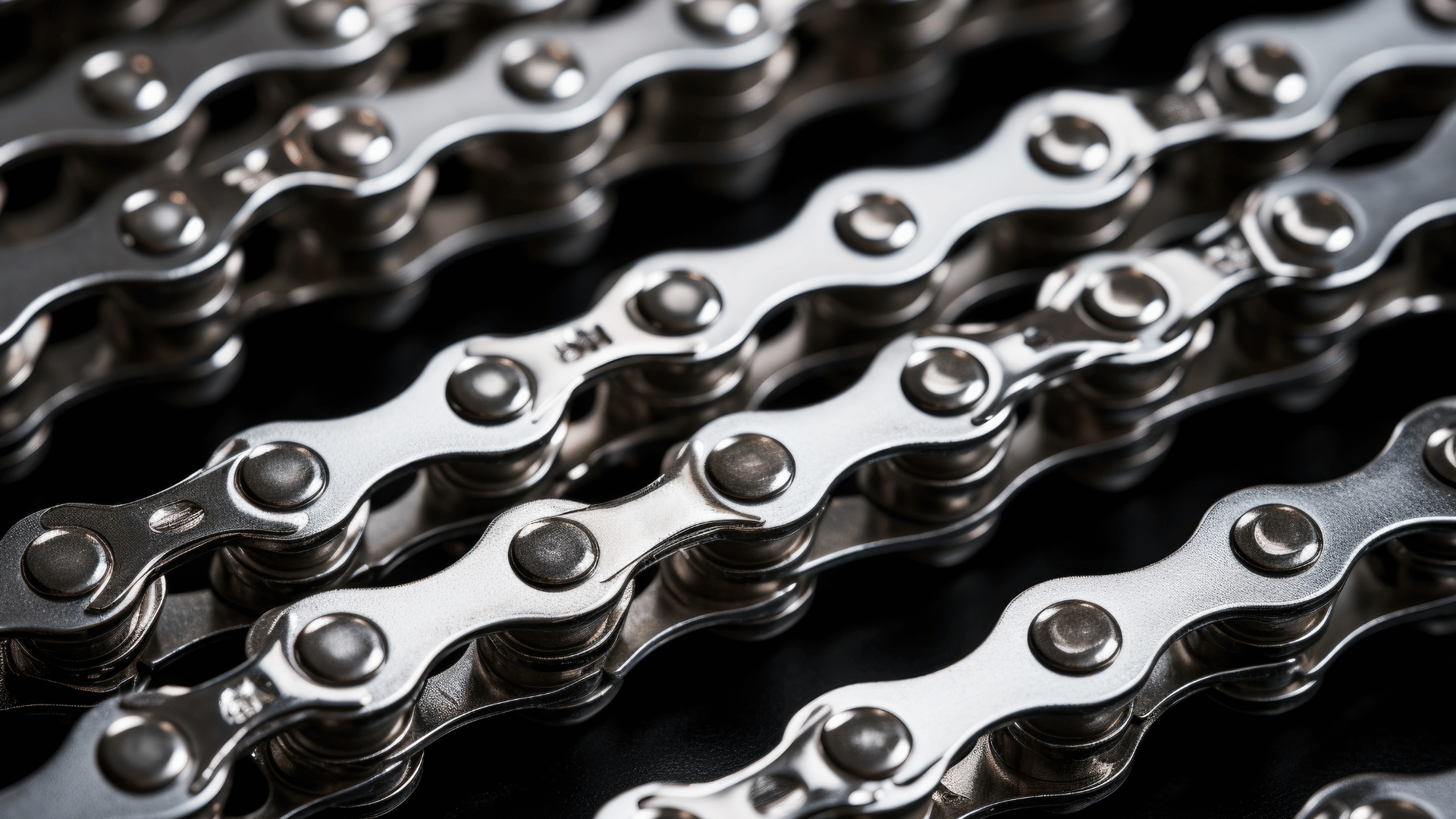
The drive system on a Suzuki motorcycle is a precision-matched assembly. Chain and sprockets are engineered together to transfer power efficiently, wear at compatible rates, and operate within the tolerances the chassis was designed around. When one component wears beyond its service limit, the others accelerate toward theirs. Understanding how to select the right OEM chain and sprockets for your Suzuki keeps the entire drive system working the way it was designed to, from the first mile of the season to the last.
This guide covers how the drive system functions as a matched set, how to choose the correct OEM chain and sprockets for your specific Suzuki model, when replacement is necessary, and how seasonal riding conditions affect your service intervals.
How the Drive System Works and Why Matching Matters
Power leaves the transmission through the countershaft, turns the front sprocket, travels along the chain, and drives the rear sprocket to move the wheel. Every link in that sequence depends on dimensional precision between the components.
Chain pitch is the distance between link pins. Sprocket tooth spacing is designed to match that pitch exactly. When a chain stretches beyond its service limit, the effective pitch increases slightly, and the chain begins to ride higher on the sprocket teeth rather than seating correctly at the base. This creates accelerated and uneven tooth wear on both sprockets. A worn sprocket, conversely, will accelerate wear on a new chain installed over it because the irregular tooth profile causes uneven link loading.
This interdependence is why replacing chain and sprockets as a set, rather than swapping just the chain, is the correct service approach in most cases. Installing a new chain on sprockets with hooked or worn teeth shortens the new chain's service life significantly and doesn't restore the handling feel of a correctly maintained drive system.
Choosing the Right OEM Chain for Your Suzuki
Chain Types
Suzuki motorcycles use three sealed chain designs.
- Standard (non-sealed) chains appear on some older and smaller-displacement models and require frequent lubrication due to the absence of internal grease retention.
- O-ring chains use rubber O-rings between link plates to retain internal grease, reducing lubrication frequency and extending service life. They are the most common design on mid-size and larger Suzuki motorcycles.
- X-ring chains use a four-lip profile seal that reduces friction compared to a standard O-ring while maintaining equivalent sealing, offering marginally better efficiency and service life on many later-model Suzuki sport and touring bikes.
Your owner's manual specifies the correct chain type for your model.
Chain Sizing
Chain size is expressed as a number such as 520, 525, or 530, where the first digits indicate pitch and the remaining digits indicate inner width. Link count varies by model and swingarm length. Your owner's manual or the Suzuki parts catalog lists the correct size and link count for your specific model year. Using the correct link count matters: a chain with too many links will not tension correctly; one with too few may prevent the rear axle from reaching the correct slack adjustment.
OEM vs. Aftermarket Chains
Genuine Suzuki OEM chains are manufactured to the pin diameter, plate thickness, seal material, and tensile strength specifications determined for each model. For standard replacement, OEM chains provide the most predictable service life and fitment certainty. Browse Suzuki motorcycle OEM parts to find the correct chain for your model.
Sprocket Selection for Your Suzuki Motorcycle
Front (Counter-Shaft) Sprocket
The front sprocket is smaller, rotates faster, and wears proportionally faster than the rear. It is the first place to inspect when evaluating drive system condition. Signs of wear include hooked or asymmetric teeth, visible thinning of the tooth profile, or a shark-fin shape when viewed from the side. The front sprocket typically mounts behind a cover and is secured by a retaining plate and bolt; the service manual specifies the correct torque and any threadlocker requirements.
Rear Sprocket
Rear sprockets see lower rotational speed but greater tension loads. Wear appears as the same hooked or thinned tooth profile as the front, and can also include wallowing of the sprocket mounting holes if the retaining hardware has been improperly torqued. Aluminum rear sprockets, common on sport models, are lighter than steel but wear faster under demanding conditions, particularly on bikes with significant power.
Gearing Considerations
Suzuki specifies front and rear tooth counts that optimize the transmission's gear ratios for each model's intended use. OEM sprocket tooth counts represent the correct baseline for direct replacement, restoring the factory gearing your transmission and speedometer calibration were designed around. Our support team is happy to discuss what's appropriate for your specific application if you have questions beyond standard replacement.
When to Replace Chain and Sprockets
Measurement and visual inspection together tell the complete story.
Measuring chain stretch:
Place the chain under normal tension on the bike with the rear wheel at the tightest point in its arc. Measure a 20-link span from pin center to pin center. Your service manual lists the maximum allowable 20-link measurement for your chain; chains that exceed this limit should be replaced. A standard rule of thumb used widely in the industry is that a chain has reached service limit when it has stretched approximately 1% of its nominal length over a 20-link span, though the service manual specification for your model is the authoritative number.
Tooth wear patterns:
Inspect front and rear sprocket teeth for hooked, thinned, or asymmetric profiles. Any visible hooking indicates the sprocket is past its service life.
O-ring condition:
On O-ring and X-ring chains, inspect the seals visible between link plates. Cracked, missing, or flattened seals indicate the grease retention function has been compromised, and the chain's remaining service life is reduced regardless of measured stretch.
Replace as a set:
If the chain is at or near service limit, replace the front and rear sprockets at the same time. If either sprocket shows visible tooth wear, replace the chain and both sprockets together.
Seasonal Considerations for Drive System Maintenance
Riding conditions directly affect drive system wear rate. Highway riding at consistent speeds is relatively gentle on chains and sprockets compared to stop-and-go commuting, which subjects the chain to repeated acceleration shock loads. Trail and dual-sport riding in mud or sand accelerates wear through abrasive contamination of O-ring seals.
Spring is a natural time to measure chain stretch and inspect sprocket condition after the previous riding season. Fall inspection, done before storage, gives an accurate picture of whether replacement is needed and allows components to be sourced without the supply pressure of peak spring demand. Regardless of season, regular chain lubrication after washing or every few hundred miles is the single most effective habit for maximizing drive system service life.
Frequently Asked Questions
Should I always replace the chain and both sprockets at the same time?
In most cases, yes. If the chain has stretched to its service limit, the sprockets have worn to match that stretched pitch. Installing a new chain on worn sprockets accelerates wear and doesn't restore correct drive function. The exception is a chain replaced at a short interval due to damage rather than wear, where sprocket inspection confirms teeth are still within specification.
How do I measure chain stretch correctly?
Support the motorcycle so the rear wheel is off the ground. Move the chain to its tightest point (chains wear unevenly). Measure from the center of one pin to the center of a pin 20 links away under light tension. Compare the measurement to the service limit in your owner's manual.
What is the correct chain slack specification for my Suzuki motorcycle?
Chain slack specifications vary by model and are listed in your owner's manual under the drivetrain or chain section. They are typically expressed as vertical movement at the midpoint of the lower chain run with the swingarm at a specified position. Following the model-specific specification ensures correct tension across the full suspension travel range.
How often should I lubricate my motorcycle chain?
Most manufacturers recommend lubrication every 300 to 600 miles under normal conditions, and immediately after washing or riding in rain. Apply lubricant to a warm chain at the inner link faces, rotating the wheel slowly to coat all links, and wipe excess from the outer plates before riding.
Can I replace only the front sprocket if it's the most worn?
Only if the rear sprocket and chain are both within specification after a full inspection. Because sprocket and chain wear are closely linked, a full inspection of all three components is the correct starting point before deciding on partial versus full replacement.
Keep Your Suzuki Drive System in Factory Condition
A correctly maintained chain and sprocket system delivers smooth, efficient power transfer and consistent, predictable handling. Genuine Suzuki OEM chains and sprockets restore the precision the drive system was designed to operate with, without the fitment uncertainty of non-spec alternatives.
Browse the Suzuki motorcycle OEM parts catalog to find the right chain and sprockets for your model, or contact the Carolina Cycle support team if you need help confirming the correct specifications before ordering.
